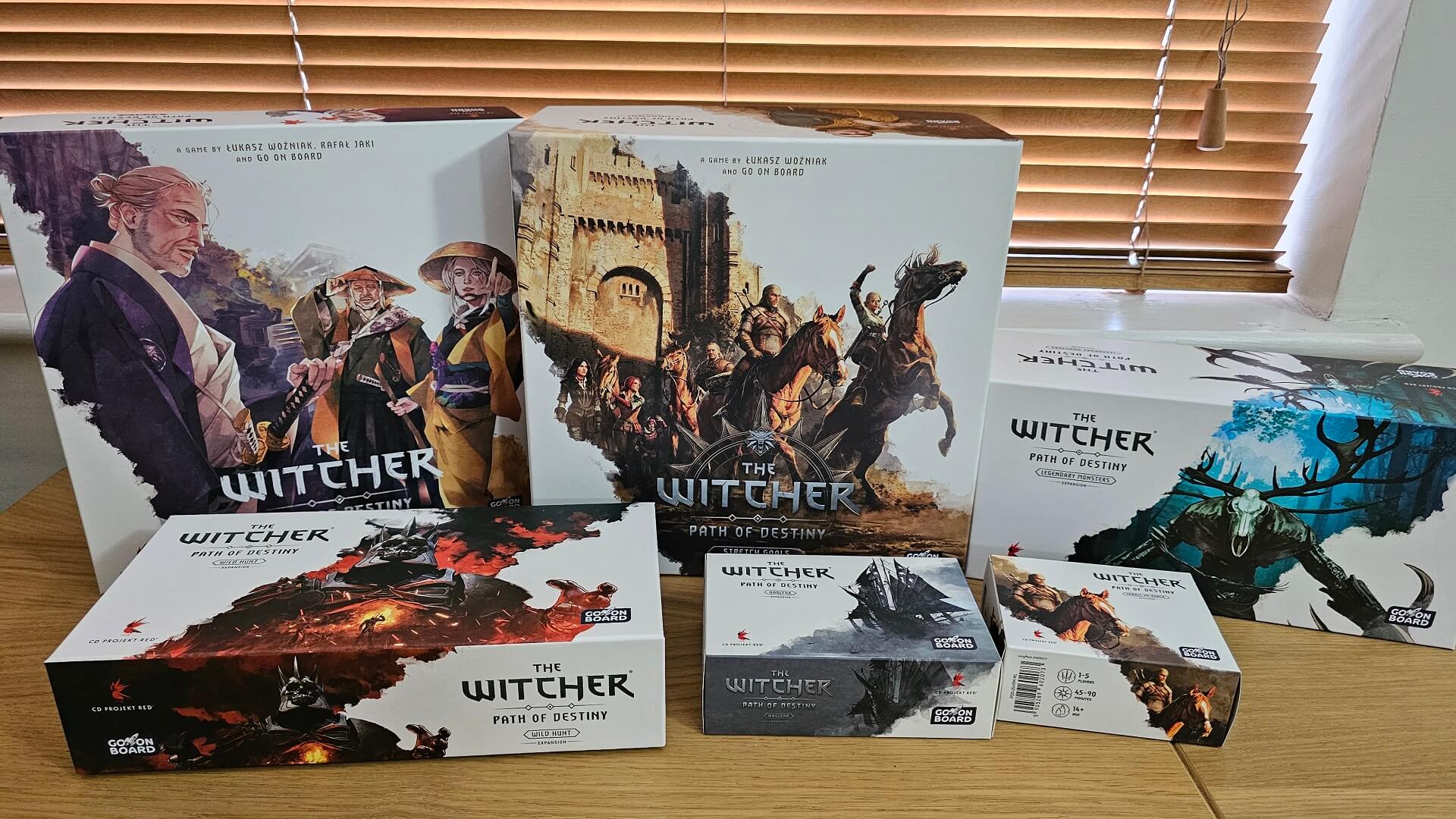
We recently reviewed The Witcher: Path of Destiny, and while we were unimpressed by its lack of strategic depth and paper-thin The Witcher theme, we persevered with the available expansions to see if they added anything more to it. Some of these expansions are crowd-funding only, and we'll specify which are available and retail and which aren't.
We previously covered The Witcher: Old World and its expansions, as well as the recent Unmatched sets, featuring characters from The Witcher. You can also read our review of The Witcher 3, and check out our news for the upcoming The Witcher 4.

The Witcher: Path of Destiny Stretch Goals
In The Wticher: Path of Destiny Stretch Goals box from the crowdfunding campaign, there are several new characters, stories, and extra play options, some of which will be available at retail eventually, and some are exclusive to the crowdfunding.
The Path of Destiny stretch goals box includes:
- 5 new characters
- 5 new tales
- Companion and Villain additional play options
- Voice of Reason additional play options
- A new solo opponent board
The 5 new characters offer more of the same from the core game. They're a welcome addition, providing multiple options, including for solo opponents, but they still lack the depth and feeling I'd like in order for them to feel like real characters. Dijkstra and Letho feel the most thematic, with Dijkstra's initiative interaction and card selection abilities, and Letho's messing with other players, but they're all still let down by the once-per-game abilities that don't have a consistent enough impact to make you feel any different from any other character.
The 5 new tales offer a huge amount of replayability from those in the core set, giving 8 in total when all combined, but they all suffer from the core mechanics' lack of depth. The Skellige tale is the most stand-out, with a built-in mini-game where you try to work out who the killer could be.
The Companion and Villain cards add some more interaction with a companion card being placed by one of the face-up card drafts and offering use of their ability if the player picks those cards. 5 companions are available, each with 5 cards (except Zoltan, who has 6, including the crowdfunding exclusive Field Marshal Windbag card). The villains are all crowdfunding exclusives, with 2 of them, Leo and Vilgefortz, having 3 of their cards suffed into the normal card deck, gaining the players victory points when they're defeated, and Gaunter offering a pact, with a victory point bonus or loss if its condition is met or not.

The Voice of Reason envelopes offer a legacy element to the game, with 9 envelopes (1 for each of the 8 tales and 1 for the Path of Destiny Ronin tale). Once the conditions on the envelopes are met, they can be opened and their components added to your game. We won't spoil any here, but it is very cool to have elements permanently added when playing through new tales, especially if you're playing with the same group, or through a solo play-through campaign.
The stretch goals also include a double-sided solo board for playing against the Crimson Avenger/Crimson Asshole, which adds a bit more variety on top of the 5 extra solo boards for the new characters in this pack.
The first retail release that includes the strech goals products is Triss A Grain of Truth, which has the Triss character, the Grain of Truth tale and the miniatures for both in the pack.

The Witcher: Path of Destiny Legendary Monsters
The Legendary Monsters expansion for The Witcher: Path of Destiny feels like what I wanted the core game to be. The focus is on fighting 1 of 4 available monsters, Ancient Leshen, Hym, Katakan, and Aguara. There are no tale cards, and the sole symbol is the fight symbol, with players needing to convert the other symbols to deal damage, or keep them to meet condition cards to gain experience.
This focus feels like it should have been the core gameplay all along. It doesn't even need to be monsters, the story cards could have contained the element players needed to work towards, chipping away at the target number, rather than the disconnected focus of trying to get symbols and work out what others might be getting. It's such a simple change, but the Legendary Monsters expansion completely changed my Path of Destiny experience and brought the theme to the front. The characters still don't feel unique or thematic enough for me, but the end experience was much more rewarding, it's just a shame it focuses on combat and not the other elements that make The Witcher so great.

The Witcher: Path of Destiny Wild Hunt
The Wild Hunt is another great The Witcher: Path of Destiny expansion that changes the gameplay to either 1 player controlling the Wild Hunt vs all the other players, or a solo player playing against the automa Wild Hunt. It uses the expansions' own Tale and follows mostly the same rules as the core game, only this time you are competing directly against the Wild Hunt, with their own character board.
On top of their character board, there is also a general's play mat that each of the 4 Wild Hunt generals advances on a track, gaining effects as they do. Each general also has an ability card that usually causes issues for the other players. These abilities, combined with the standard abilities on the player board, go some way to making the Wild Hunt feel thematically worthwhile, which will leave the other player feeling pretty jealous with their bland characters with limited in-game effects.
As with Legendary Monsters, it's such a shame that this is an expansion, and not the core gameplay, because it locks you into the single tale in this pack, rather than being able to take the most thematically feeling parts of the expansions, and use them in the core game. This means that while both of these expansions are fun, the replayability is limited, while the core, more lifeless game, has 8 tales for a lot more replayability.

The Witcher: Path of Destiny Naglfar
The Naglfar mini expansion for The Witcher: Path of Destiny is a crowdfunding excuslive expansion for the Wild Hunt, or Legendary Monsters expansions, and requires the core game and one of those expansions to use.
In the Wild Hunt, the Naglfar ship protects a general from the players, and the players get access to the Broken Sextant cards to offset that, which do things like ignore the ability of the general protected by the Naglfar. In Legendary Monsters, you can use the Naglfar expansion to make the Wild Hunt a monster against which the players battle.
It's a nice expansion, adding another dynamic to the game, but if you missed it at crowdfunding, it's not an essential gameplay inclusion, unless you love Legendary Monsters, in which case this adds more than it does to the Wild Hunt expansion.

The Witcher: Path of Destiny Geralt On Roach
The Geralt on Roach expansion for The Witcher: Path of Destiny is a crowdfunding-only expansion and won't be available at retail. Luckily, it doesn't add much to games, so if you missed it, you're not missing out on much. The expansion includes a miniature, a player board, and 5 starting cards for Geralt on Roach.
The miniature, as you would expect, shows Geralt mounted on Roach, drawing one of his trademark swords from his back. The player board changes Geralts' once-per-game abilities from the core set, adding in some randomness, allowing you to reveal a random card for an effect. The 5 starting cards are exactly the same as those in the core set, just with different art.
The one area that would have made this expansion interesting would have been a change to the starting cards. They're what gives you the most strategy in game, and differentiate the characters the most from each other. The once-per-game effects have little serious effect, and Geralt on Roach's are completely random, so beyond using the expansion once for fun, you'll be back using the core set Geralt.

The Witcher: Path of Destiny Ronin
The Witcher: Path of Destiny Ronin isn't an expansion for The Witcher: Path of Destiny, it's a standalone game that uses most of the rules from the core game, with a few subtle differences. The main difference in the mechanics is that between each player, an alliance board is placed. These boards allow players to unlock their partner's abilities for use, which is done by playing matching symbols on the cards used in the draft, which include teacups facing different directions. Players need to play these cards facing each other to progress on the alliance board.
The other difference is that the tale cards don't have any text on them, the chapter cards simply detail which symbols are the active symbol for that chapter, and 2 of the 4 active symbol cards are put on the board. Victory and experience points are also reversed from the core game, with players now scoring victory points for the active symbol they have the least of, and experience points for the active symbol they have the most of.
Aside from the aesthetics, which are thematically glorious, Path of Destiny: Ronin doesn't feel that much different from the core game, which is still that the characters don't feel much different from each other, and apart from the focus on partnerships, it doesn't really feel much like The Witcher, and the card playing to match symbols feels a bit lifeless when compared to the art and components.
The art throughout is great, and when combined with the bamboo play mat, it looks amazing on the tabletop. It's just a shame that it won't be out much, because the core gameplay isn't up to scratch, and the fact that it is completely standalone, so the good parts of Legendary Monsters, the Wild Hunt, and the tale elements of the core game can't even be used as part of it.
What Are Our Final Thoughts On The Witcher: Path of Destiny Expansions?
The Witcher: Path of Destiny has some great expansions. Wild Hunt and Legendary Monsters both make the game feel like The Witcher, and should have been the core game. The fact that most are incompatible with each other just emphasizes the lack of join up with the products. The stretch goals, with the extra characters and tales, just add more of the same, and don't help the mechanics grip the theme, or add much variety beyond the tales' flavor text and once-per-game abilities of the characters. The voice of reason envelopes are a great addition, and add a fantastic legacy feel to the game, especially when playing in a consistent group, but I'm not sure the mechanics have the scope for that level of replayability, when all the new character and tale variety just add more of the same lack of depth.
Path of Destiny Ronin looks glorious, and the gameplay changes are interesting, but it changes nothing in terms of how light the gameplay feels, and the lack of difference between the characters fails to capture any feeling of theme with them. It's also frustrating that it's completely standalone, and none of the other expansions, which are what save the core game, can be added to this.
The copies of The Witcher: Path of Destiny Expansions used to produce this review were provided by Asmodee UK and purchased by the Author.
Review Summary
Pros
- The Witcher Path of Destiny Ronin look incredible.
- Wild Hunt and Legendary Monsters change the core set and actually make it strategic, fun and thematic.
- Voice of Reason envelopes add some fantastic legacy elements.
Cons
- Lack of compatibility across the expansions just emphasizes the lack of join up.
- Most of the stretch goals add more of the same, adding more variety, but still failing to make the game feel thematic.

Adam is a Tabletop Specialist for TechRaptor. He started writing for TechRaptor in 2017 and took over as Tabletop Editor in 2019 and has since stood down… More about Adam