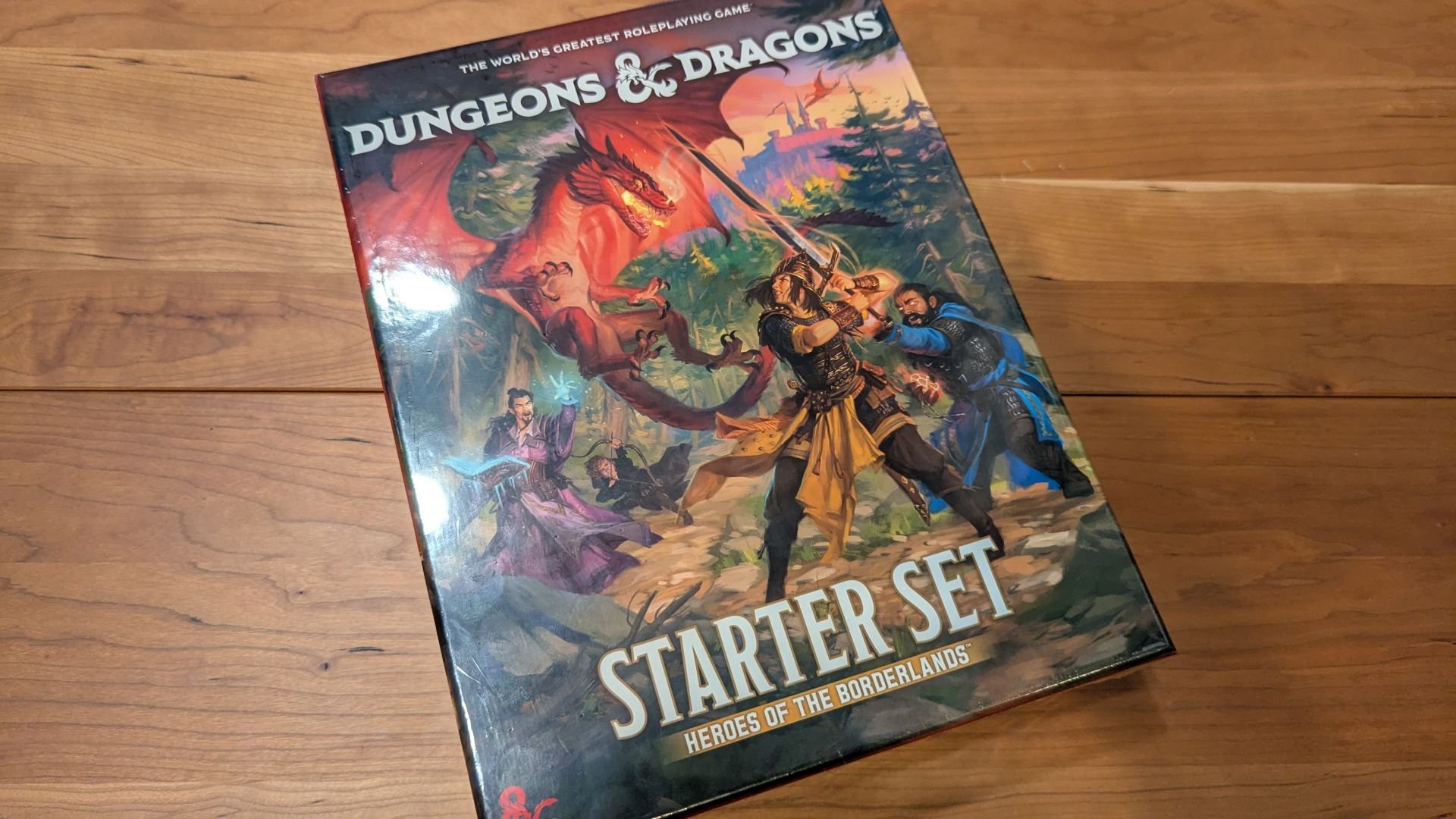
With the continued popularity of Dungeons & Dragons, and how it's leaking out all over various forms of media and pop culture, every day, there's someone experiencing their first game of Dungeons & Dragons. If no one in your group has played before there have been Starter Sets that are a decent place to start, but with the release of Heroes of the Borderlands, there's now a best place to start.
What's In The Heroes of the Borderlands Box?
Inside the Heroes of the Borderlands Box a DM will be able to find:
- Four Booklets: 1 for the basic rules (essentially taken from the 2024 DMG), and three Adventure Booklets (One for the Keep, one for the Borderlands, and one for the Caves of Chaos)
- Character sheets for Cleric, Rogue, Wizard, and Fighter from levels 1-3 (including two different sub-class options)
- Game Cards for spells, equipment, magic items, NPCs, Monsters, and more
- Tokens to represent players, monsters, and unique terrain
- 18 maps including overworld maps as well as battle and dungeon maps
- Handouts related to shopping locations and key NPC interactions
- A set of 11 dice (the core polyhedral set with one extra D20 and three extra D6)
- A pad of Combat Initiative Tracking sheets
- Four plastic ziplock sleeves (for keeping player cards together for extended games)

I was blown away by just how much was in the box. Having learned to play D&D myself with the Mines of Phandelver starter kit I was all too familiar with how much there can be to learn, how information can be spread all throughout the rules and adventure books, and trying to 'prepare' could have you pulling information from all over the place.
Splitting out all of the relevant information among cards, it creates a more component-heavy experience, but splits up the learning and the onus of having that knowledge among all of the players and doesn't just rely on the GM to take on everything.
The best way that I can think to describe it is that by making it more component-heavy, and tweaking things like the character sheet, they've 'board game-ified' Dungeons & Dragons and created an experience that you could just pick up and run on a whim.

Including monster and terrain tokens alongside maps feels like a more sensible approach to an official way to start playing as opposed to purchasing a Starter Set and then also picking up something like a Campaign Case. This feels like the evolved form of them all.
Creating Your Character
The character sheet for Heroes of the Borderlands has been completely redesigned to be as beginner-friendly as possible and to work in conjunction with the card system that has been developed.
In front of the player, they'll be able to see each of their abilities and the modifying values (organized by stat and not alphabetically), stats such as speed, initiative, and HP, and their class features. To the right of their sheet, a player also has an indicated space for their species and background cards to be played.
Taking up the center of the card is space for players to place their equipment cards or stack up their spell cards. Within each of these spaces, you'll see recommendations for equipment as well as rules relevant to that space on your player board.

The last part of putting together your character is collecting the required health, ability, and gold tokens to have a visual representation of these components on your board. As a player, you likely won't ever need to pick up a pen to note something or keep track of your stats and abilities.
Placing your starting equipment on your player board, you can immediately understand the capabilities of your character, how to hit something or deal damage, how many uses you have of any ability, and understand how class features, species, and background can all work interchangeably.
Spellcasters have the added bonus of having cards for each of their spells. The back of each card features the full rules for a spell, while the front gives quick information such as the range and area of effect. For spells that call on a cone, or a magical effect in a range centered on the player, there's even a diagram showing you how it will work.

While there will be a learning curve, going from this sheet to a normal character sheet or a digital D&D Beyond sheet, for a beginner with no prior knowledge, this character sheet is clear and approachable.
The only part of this character sheet that I can really fault is the health tokens. Gold, which is spent less frequently, makes the exchange of tokens fun, and the ability tokens moving off or returning to the board is easy enough, but swapping out HP tokens can be a bit of a pain.
I would have loved to have seen some kind of sliding tracker. Letting you move a HP token up and down your maximum health bar for the side of the character sheet you were on. It would have saved some time swapping out a 5hp token for 3hp tokens, only for the character to drink a potion and need more tokens again.

Adventures At The Borderlands
The new Dungeons & Dragons Starter Set puts a party of four and their Dungeon Master in the Borderlands. This is an update of the setting from the 1979 D&D adventure, Keep on the Borderlands. Time has moved on, and it's a good, setting-agnostic location to branch out and explore more of the world after getting comfortable with what's in the book.
In the Keep booklet, you'll have multiple locations for your party to visit in town. These can be roleplay locations, like the chapel or shops, to acquire new goods at. To further assist in shopping, you'll also find handouts for the different items on sale.

Each location has an NPC to meet and an odd job that they might be recruited for. These jobs will test not only players' roleplaying skills, but also prompt them for a variety of skill checks. While simple, these checks serve as a built-in tutorial for what you can do with your different abilities.
The Wilderness book provides you with some random travel encounters. These are a mix of combat and roleplay, and it's also where you'll find the combat tutorials for players. Easing them into gameplay with a combat encounter on the side of a road.
The final book is for a series of caves that each act as a mini-dungeon with a theme. It might be goblins, cultists, spiders, or really any other staple Dungeons & Dragons monster that inhabits them. Each adventure is a short series of rooms with combat and exploration so it's easy to get in and out of with very little notice.
There is definitely a downside to not having a planned and structured adventure like the Mines of Phandelver, but the upside is that Heroes of the Borderlands has more than enough content for planned mini-adventures and to teach all of the basics for a party to understand what kind of adventure they might be into before they set out on a larger adventure.

Dungeon Master Assistance For First Timers
For a new DM running a game can be a somewhat daunting task. There's a few ways that I think this Starter Set tackles things fantastically.
The first is in the separation of the information across quick to reference cards. You'll reach a new place at the Keep, or a new dungeon, and the book will inform you of exactly what NPC cards, monsters, etc you'll need. You can keep them to the side, all with their relevant information, and you never need to be flipping through a book or trying to determine what to do next.
The other way that these adventures make being a DM easy is by maintaining a bite-sized approach. There isn't any grand story that will take the party from level 1-5, but there's roleplay to perform at the Keep, random encounters to have in the Wilderness, and then a plethora of caves that act as multi-room dungeons.

Because each encounter or setting has only about a page worth of information no matter where the party goes you'll never need to read much to stay ahead of them.
This bite-sized information also means that each session can be ~2 hours without needing much prep time, and the role of DM can rotate around the table. You might have DM'd for Caves A and G, but that doesn't mean you know what's going on in Cave E when it's your turn to be a player.
Dungeons & Dragons: Heroes of the Borderlands Review | Final Thoughts
This box set is absolutely the way anyone new should be getting into D&D. The massive benefits that this has is a large number of bite-sized adventures, a unique approach to character creation and stat tracking that creates a more casual experience, and the lack of a need to do any major prep.
The only recommendation I'd make for players is organize a different way to track health so that you aren't worrying about moving a whole bunch of health tokens around.

By the nature of the shorter adventures and mini-dungeons you won't get the same sweeping narrative as you might in the other Starter Sets or full Adventure Books but by playing Heroes of the Borderlands with your friends you'll be able to solve the basic questions of finding out who wants to be the longer term Dungeon Master, and what type of adventure/playstyle you're most interested in.
Alternatively, Heroes of the Borderlands opens D&D up to being a casual game night endeavor where any group of up to five friends can casually create some characters, and run through a micro-dungeon with next to no prep necessary.
While the cost has increased compared to previous Starter Sets it's well worth it with so many tokens, reference cards, and maps that you can continue to use time and time again.
Dungeons & Dragons: Heroes of the Borderlands was reviewed with a copy provided by Wizards of the Coast over the course of 10 hours of gameplay - all photos were taken during the process of review.
Review Summary
Pros
- Easy setup
- Bite-sized adventures promote role rotation
- Useful components
- Carries forward to other adventures
Cons
- Health Tokens Aren't Useful
Andrew has written Video Game and Entertainment news, reviews, and guides for 10+ years. As Senior Content Manager, he assists in creating and editing… More about Andrew