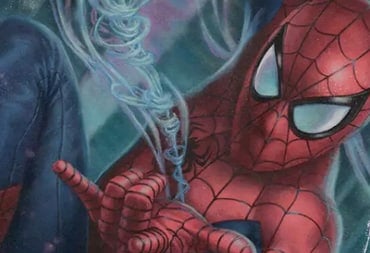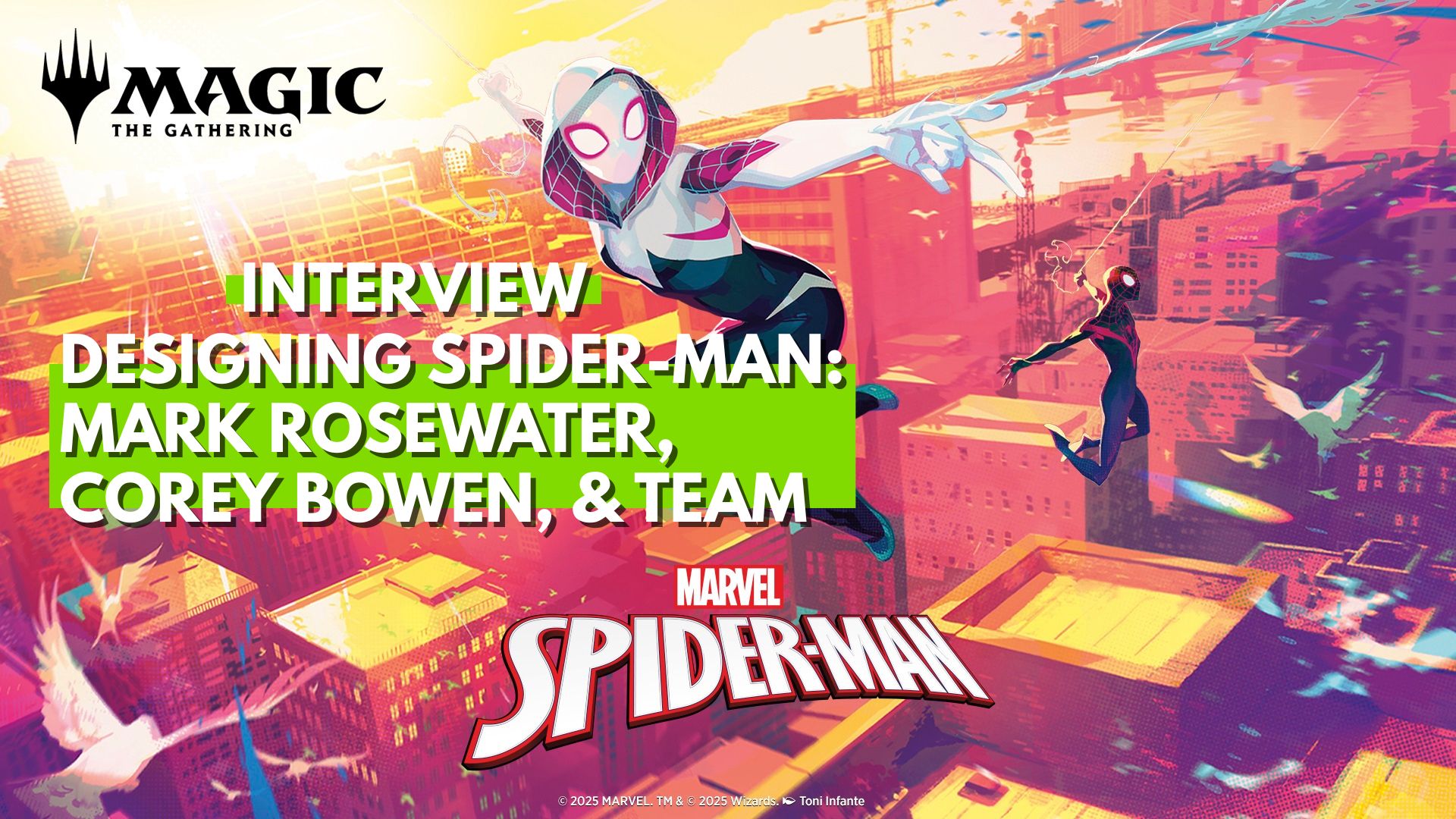
News that Spider-Man, and more broadly Marvel, would be coming to Magic: The Gathering made waves a few years ago through their offices, particularly with Magic’s Head Designer Mark Rosewater. With just a few days until the set releases, I had the chance to talk to Rosewater, the set’s Lead Designer Corey Bowen, Principal Designer Jadine Klomparens, and Senior Art Director Sarah Wassell about everything Spider-Man and how they translated it to Magic.
What Makes Spider-Man Spider-Man?
Spider-Man is the most popular superhero in the world, so there’s obviously a lot people love about the character and the world he lives in. For Universes Beyond, translating the core pillars of why people love any one franchise is key to the set’s design.
So, I asked the team what it was they loved about Spider-Man and what they wanted to make sure showed up in the set. Rosewater hit what I think is what most people are drawn to with Spider-Man:
Superheroes are kind of larger than life ... They were grander than you and they’re something you could look up to and admire. But Peter Parker was you. He had actual problems that you had... Peter Parker is late on his rent and has trouble getting a date, you know?
For each Universes Beyond set, the team identifies who could serve as Subject Matter Experts for the property they are adapting. These are people very passionate and knowledgeable about whatever they're adapting and could come from anywhere in the company. They then become key resources and sounding boards throughout the design process.

In Spider-Man's case, Rosewater served that role with some others, so his keying in on what he loved about Spider-Man, an everyday guy who happens to be a superhero, is something that shines through the set.
Personally for Rosewater, he said that when he heard they were talking to Marvel about making sets with their properties, the concept of Universes Beyond fully clicked with him. He now could feel the same level of excitement others in the offices felt about things they were deeply passionate about making their way into Magic.
Bowen expanded on the key aspects of Spider-Man and how they approached designing cards:
A lot of times he’s making choices between should I be a hero? Should I cater towards my life? ... We try to really make sure we had a lot of family moments, a lot of those grounded moments in the set.
Specifically, Bowen mentioned that is why there are quite a few Modal choice cards in the set. The choice of what ability you activate mirrors the choices Spider-Man is faced with.
 |
 |
School Daze is a card where Peter is stuck with the choice of suiting up to protect the city or get his homework done. Another one Bowen mentioned was Heroes’ Hangout, where the tension between the dual-life of any of the heroes plays out.
For Bowen specifically, he really loves the relationship Spider-Man has with villains. The balance between the serious and humorous is something that stands out, where Spider-Man is constantly quipping and making jokes, talking with the villains.
 |
 |
Flavor text on the cards did a lot of the heavy lifting here, with little quotes of Spider-Man making fun of the likes of Vulture or Rhino.
Making the Abstract Into Cards
Moreso than in other sets of Magic, I noticed that there are a lot of “high concept” cards in Spider-Man. By that I mean, they’re not exactly obvious as ideas for a card. Web a guy? Easy card. Rent is Due? Not something you maybe think of right away.

I asked for a little bit more on the design process of Rent is Due. In this card’s specific case, Bowen said they wanted a card to show Peter’s bad luck, the troubles he has in life.
Rent is Due was one of the more difficult cards for the team to design Klomparens said, but they eventually landed on having it synergize with treasure.
There’s a few ways cards come to be in Magic, and a lot of the time it’s a question of what the set needs. There may be a lack of synergy in one color or maybe they need more cards to fit the identity of one color, like some more card draw in blue for example.
With Universes Beyond more often than your standard sets, they get to start from the point of: how do we get the flavor of the set right? What do we absolutely need to make this set feel like Spider-Man, Final Fantasy, or Lord of the Rings?
Rent is Due was one of those cards that started out as just a concept of a card that would convey Spider-Man in a great way. “Parker Luck” is such a big thing to fans they wanted to make sure it was represented in the set, so the challenge is how they can find a satisfying mechanic that will make sense with the flavor of the card.

Klomparens said that Rent is Due is an example of a card they probably wouldn’t have come to naturally if they were just designing cards in the normal process. It was something necessitated by the property they were adapting and a concept their subject matter experts like Rosewater identified early on.
As a designer, Rosewater said that is one of the beautiful things of making Universes Beyond. They get to start designing in a place they never would have started before, which naturally leads to cards they haven’t made before.
The Art of Spider-Man in Magic
It would be impossible not to talk about the art of Spider-Man in this set. There are a ton of iconic moments, covers, and panels from the long history of the comics, meaning that the team had an embarrassment of riches to draw from.
Because comics are already a medium that has strong visual language, which Magic cards necessitate as well, they had a lot of strong material to both be inspired by and to identify as something to use for things like bonus sheet cards or alternate art.
For senior art director Wassell, she said it was very intimidating:
There’s so much of it and there’s such a legacy. It’s such a popular thing and people know so much about this stuff, you know? Working on Universes Beyond is such a challenge... Once we started on Marvel ... we got to really dig into this to make sure that we’re doing it justice because we didn’t want to leave anything important out.

Wassell said that the team of art directors all knew they would need to do a ton of research to do this right, to make sure they didn’t miss anything obvious. Part of the difficulty in that is that even just for Spider-Man, there are over 60 years worth of comics to take into consideration.
She mentioned that they luckily had “enough brains around” and the subject matter experts like Rosewater to help narrow down their focus. It was a lot of group conversations and brainstorming to get it right.
I asked how the process went a little more and how they approached representing the various runs and eras of Spider-Man.
Rosewater said they had this program that was like a giant wall that anyone could put up comics, certain panels, covers, or whatever they like on it to show they thought it was a good candidate to use for a card or as inspiration. That's where a lot of it started.

Certain iconic works were just immediately obvious and didn't need a ton of discussion, like breaking out of the grave for Kraven’s Last Hunt or walking away with his suit in the trash can.
So, Wassell said they started with those must-haves like the above. They then moved on to discuss the most exciting moments, broadening their search some more. Once they had so much material, the job then became asking questions about what they had too much of, what they needed more of, and more along those lines to narrow down the focus of what they were looking at.
I asked if they were trying to make sure the whole run of Spider-Man was represented or if they focused on a few particularly popular runs. Rosewater said they made a conscious effort to make sure they were hitting the biggest moments every decade, asking themselves what they could use from the '60s, '70s, etc.
One of the biggest boons to the Spider-Man set is just how many comic and cover artists of Spider-Man are represented, both in classics everyone has seen and new pieces using their talents. They no doubt know how to make Spider-Man look like Spider-Man.
A lot of the biggest names feature art straight from a comic or cover, like art from Steve Ditko, Todd McFarlane, John Romita, Sr., Mark Bagley, and a whole lot more. Then you have new art from current Marvel artists like Jay David Ramos, Roberta Ingranata, Lucas Werneck, and more.

Obviously, they use a lot more artists and their own not from the comics, so the team knows how to draw a Magic card. I asked Wassell if there was any real trepidation or concern handing some reins to the Marvel artists, but she said there wasn’t really much to worry about.
At most, she said that talking to artists has to do with more logistical issues. Things like “the fact that the cards are small and that the frame goes here... a lot of that work tends to just be helping artists wrap their heads around that.”
As we wrapped up our talk, I took the opportunity to ask the team for any advice as I was heading to my pre-release event immediately after. They told me they found Mayhem to be a fun mechanic that has worked well in pre-release. Hopefully I would get the cards to make a deck for it.
Well, I didn't. Thankfully, I had all sorts of green and white spider heroes to build around and ended up winning the event. Still, thanks for the advice team!
Pre-release events may have already happened or are still happening at your local game store, so you can get your hands on some Spider-Man cards now if you wish. Otherwise, the set fully releases on September 26.

Andrew is the Editor in Chief at TechRaptor. Conned into a love of gaming by Nintendo at a young age, Andrew has been chasing the dragon spawned by Super… More about Andrew